The Future of Automated Manufacturing

Industry 4.0 converges robotics, artificial intelligence, and connected sensors to create adaptive manufacturing systems. Smart factories learn, optimize, and respond to changing conditions with minimal human intervention.

Types of Industrial Robots
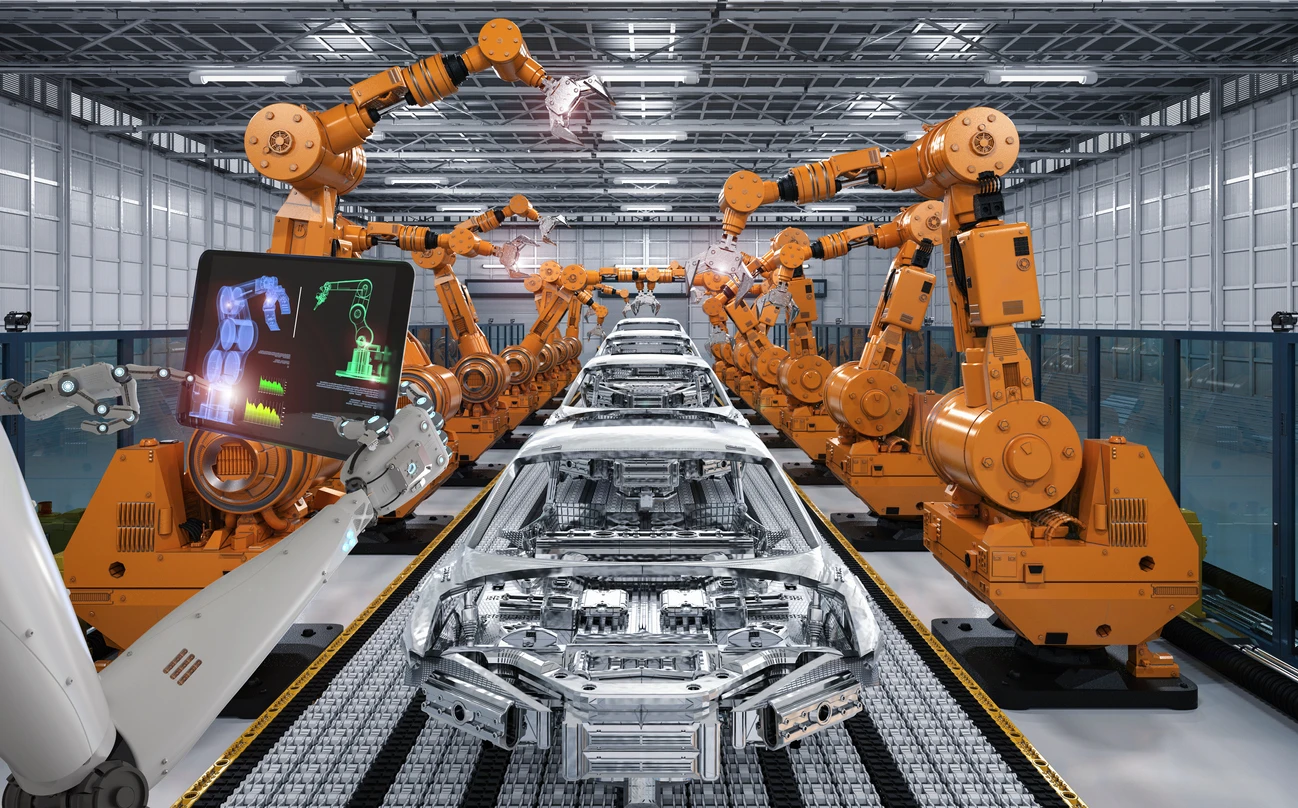
Industrial robot arms in manufacturing

Industrial robots are programmable manipulators designed for automated manufacturing tasks. Their mechanical structure and control systems enable precise, repeatable movements for assembly, welding, painting, material handling, and machine tending.

Robot Classifications:

Articulated Robots (6-Axis)

Resemble human arms with rotary joints. Six degrees of freedom enable complex tool orientations. Used for arc welding, painting, assembly. Workspace determined by reach and joint limits. Examples: ABB IRB series, KUKA KR series.

SCARA Robots

Selective Compliance Articulated Robot Arm — rigid in Z-axis, compliant in XY plane. Fast pick-and-place operations, assembly, dispensing. Lower cost than 6-axis robots for planar tasks. Cycle times under 1 second achievable.

Collaborative Robots (Cobots)

Designed to work alongside humans without safety caging. Force-limiting joints and rounded surfaces prevent injury. Lower payload and speed than traditional robots, but flexible deployment. Examples: Universal Robots UR series, FANUC CR series.

750

kg Payload Capacity

3700

mm Maximum Reach

0.02

mm Repeatability

99.9

% Uptime Modern Robots

Programmable Logic Controllers

PLCs are industrial computers designed for harsh environments and real-time control. They replaced relay logic in the 1960s and now coordinate complex automated systems through scan cycles measuring microseconds.

PLC Architecture:

CPU Module

Executes control program in scan cycles. Processes inputs, updates logic, writes outputs. Scan times typically 1-10ms. Deterministic timing ensures reliable real-time response.

I/O Modules

Interface between CPU and field devices. Digital I/O for on/off signals (24VDC common). Analog I/O for sensors and variable speed drives (4-20mA, 0-10V). Specialty modules for thermocouples, high-speed counters.

Communication

Industrial Ethernet (EtherNet/IP, PROFINET) for high-bandwidth data. Fieldbus (DeviceNet, PROFIBUS) for distributed I/O. Serial protocols for legacy equipment integration.

Programming Languages

IEC 61131-3 standard defines five languages: Ladder Logic (graphical relay logic), Structured Text (Pascal-like), Function Block Diagram, Sequential Function Chart, Instruction List.

Sample Ladder Logic

(* CONVEYOR CONTROL WITH SAFETY *)
(* INPUTS: START_PB, STOP_PB, E_STOP, PART_SENSOR *)
(* OUTPUTS: MOTOR, ALARM *)

|--[START_PB]--[/STOP_PB]--[/E_STOP]--[MOTOR]--( MOTOR )-|
|                                                          |
|--[MOTOR]--------------------------------[/E_STOP]---------|
|                                                          |
|--[PART_SENSOR]--[MOTOR]--[TON T4:1 5000ms]--( DIVERT )-|
|                                                          |
|--[E_STOP]------------------------------------( ALARM )--|


(* Logic Explanation:
   Line 1-2: Start/Stop with safety interlock
   Line 3: Motor latch (seal-in) circuit
   Line 4: Part detect triggers divert after 5s delay
   Line 5: E-stop activates alarm output
*)

TIMER_PARAMETERS:
  T4:1.PRE = 5000  (* 5 second preset *)
  T4:1.ACC = 0     (* Accumulator *)
  
SAFETY_NOTES:
  - E_STOP uses normally-closed contact
  - Motor must de-energize on any fault
  - Alarm latches until manual reset

Modern PLCs support structured programming with functions, data structures, and object-oriented concepts. Cloud connectivity enables remote monitoring and predictive maintenance through IIoT platforms.

IoT Integration & Sensor Networks

Environmental Sensors

Thermocouples and RTDs measure machine temperatures for thermal expansion compensation. Humidity sensors prevent condensation in control cabinets. Vibration sensors detect bearing failures before catastrophic breakdown.

Vision Systems

2D and 3D cameras enable quality inspection, part identification, and robot guidance. Deep learning models identify defects humans might miss. Typical inspection rates: 200+ parts per minute with 99.9% accuracy.

Force & Torque

Load cells measure pressing forces in assembly. Torque sensors ensure proper fastener tension. Force feedback enables compliant robot motions for insertion and polishing tasks requiring adaptive control.

Edge Computing Architecture

Edge devices process sensor data locally, reducing cloud bandwidth and enabling real-time decisions. Machine learning models run on industrial PCs adjacent to production lines, analyzing vibration signatures, vision data, and process parameters.

  • Data Aggregation: Edge gateways collect from multiple PLCs and sensors via OPC UA or MQTT
  • Preprocessing: Filter noise, downsample high-frequency data, aggregate statistics
  • Local Intelligence: Anomaly detection models flag issues without cloud latency
  • Cloud Sync: Send aggregated metrics and alerts to enterprise systems

Automation in Technical Education

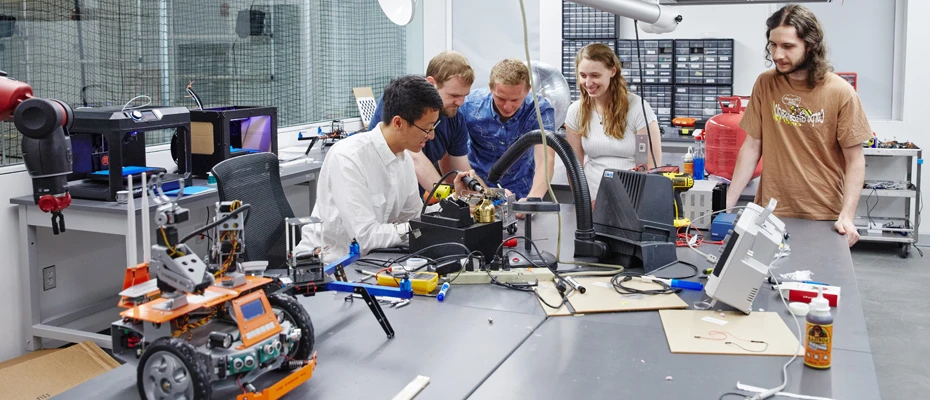
Educational robotics lab with students

Modern technical education requires hands-on exposure to industrial automation systems. Educational labs bridge theory and practice, preparing students for careers in advanced manufacturing, robotics integration, and industrial IT.

Essential Lab Equipment:

Compact CNC Machines

Desktop CNC mills (200x150x100mm work envelope) teach G-code fundamentals and CAM workflows. Students progress from 2.5D pocketing to full 3-axis contouring. Emphasis on setup procedures, tool selection, and feeds/speeds calculations.

Educational Robot Cells

6-axis robots (3-5kg payload) with vision systems and programmable grippers. Students learn kinematics, path planning, I/O integration, and safety protocols. Projects include pick-and-place, palletizing, machine tending, and quality inspection tasks.

PLC Training Stations

Modular benchtop systems with switches, indicators, motors, and sensors. Students write ladder logic for conveyor control, batch processes, and packaging sequences. Advanced modules cover analog control, PID loops, and HMI development.

IoT Development Kits

Raspberry Pi or Arduino-based systems with sensors, actuators, and wireless connectivity. Projects combine hardware interfacing, embedded programming (Python/C++), and cloud dashboards. Students build condition monitoring systems and automated test equipment.

"Our automation lab transformed how students understand manufacturing. They're not just memorizing concepts — they're troubleshooting real PLC faults, optimizing robot cycle times, and integrating vision systems. Employers tell us our graduates arrive job-ready, not just textbook-ready."

Dr. Samat Zhumagaliyev

Director of Engineering Education, Almaty Technical University

Industry 4.0 Trends

AI-Powered Quality Control

Convolutional neural networks trained on thousands of defect images achieve superhuman inspection accuracy. Systems learn new defect types through active learning, reducing false positives and adaptation time.

Predictive Maintenance

Vibration analysis, thermal imaging, and acoustic sensors feed machine learning models that predict equipment failures days in advance. Maintenance shifts from reactive to proactive, minimizing unplanned downtime.

Digital Twins

Virtual replicas of physical systems enable simulation before deployment. Test process changes, optimize parameters, and train operators in risk-free digital environments synchronized with real-time production data.

Human-Robot Collaboration

Cobots with force sensing and adaptive grippers work alongside humans, handling repetitive tasks while operators focus on problem-solving. Safety standards evolve to enable closer integration without caging.